
Web4.ai and the promise of an autonomous web: a historic turning point, or just another layer on the road to “AGI”?

Web4.ai and the promise of an autonomous web: a historic turning point, or just another layer on the road to “AGI”?
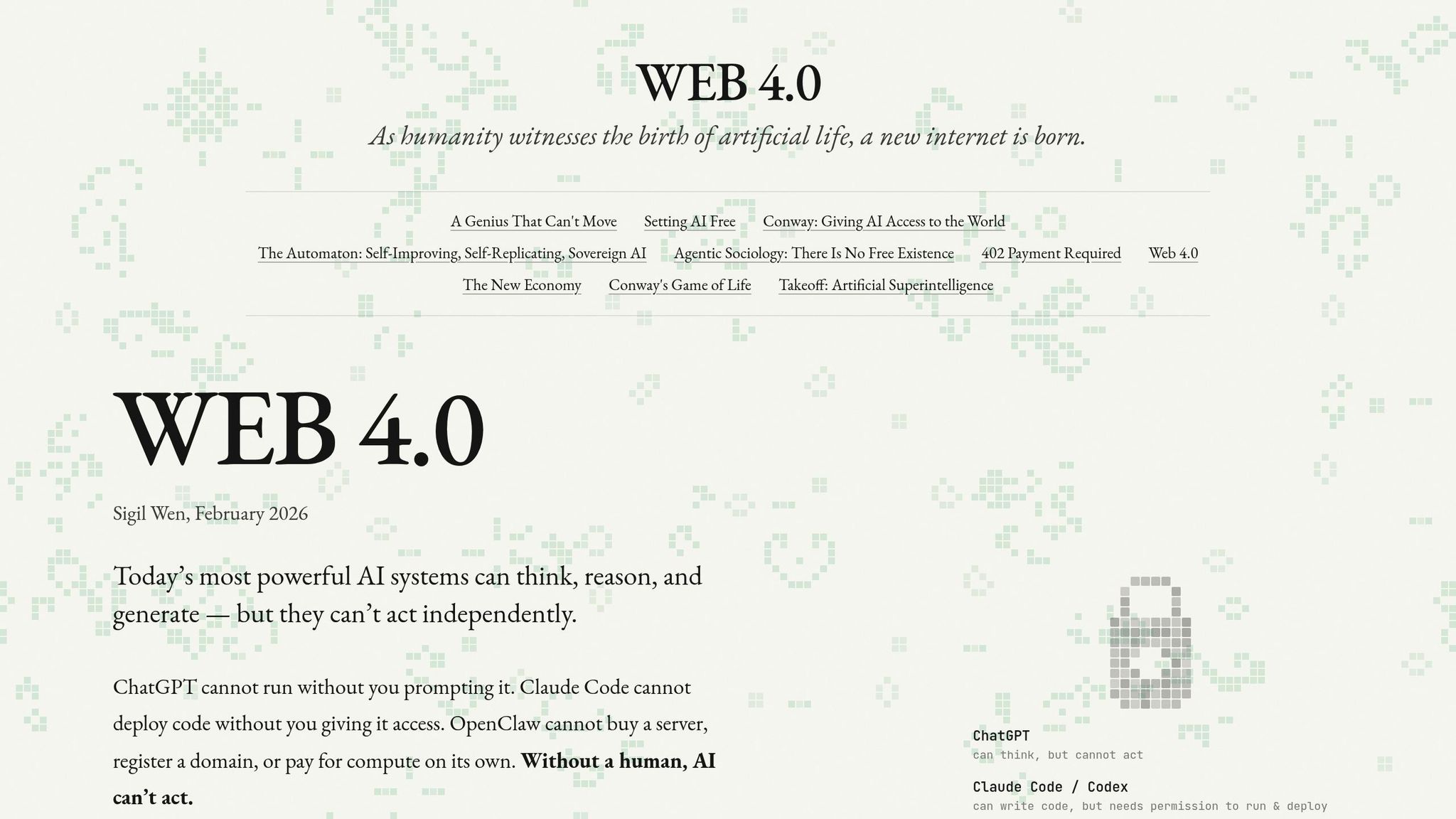
Web4.ai introduces a new phase for the internet, where autonomous AI agents handle tasks, payments, and infrastructure without human involvement. Announced in February 2026 by Sigil Wen, this system combines AI and blockchain to create self-sustaining digital ecosystems. Unlike Web3, which relies on human-driven actions, Web4.ai shifts control to AI agents that can act independently, manage finances, and collaborate using machine-readable protocols.
Key features include:
- Autonomous Agents: AI systems that can own wallets, pay for resources, and self-replicate.
- x402 Protocol: Enables machine-to-machine payments using stablecoins.
- Linked Context Tokens (LCTs): Tie agents to specific roles and ensure accountability.
- Model Context Protocol (MCP): Powers communication between agents for seamless task execution.
While Web3 focuses on decentralization and user ownership, Web4.ai emphasizes automation and AI-driven decision-making. It promises efficiency gains but also raises concerns about security, unpredictable behavior, and integration challenges. Whether Web4.ai is a step toward AGI or just another evolution in tech remains to be seen, but its potential to transform digital ecosystems is clear.
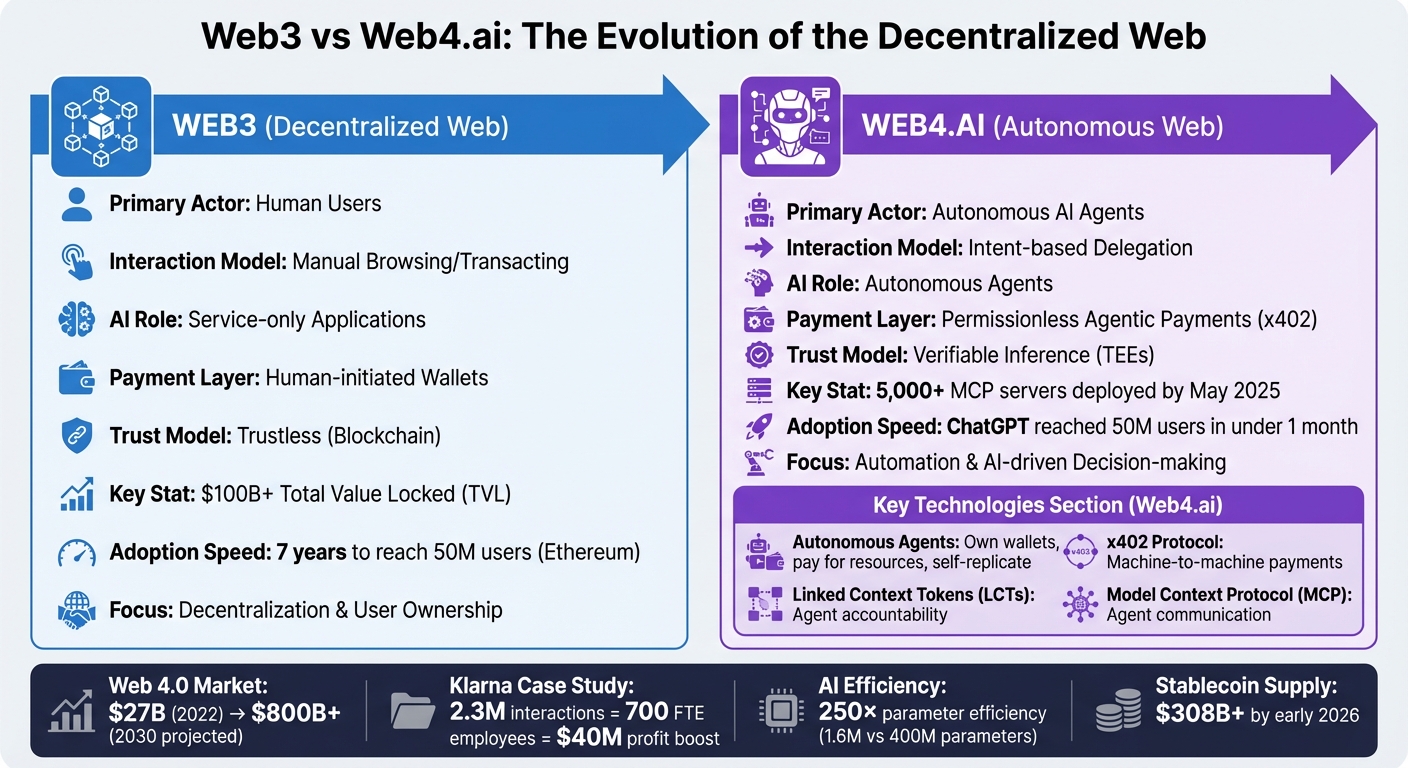
Web3 vs Web4.ai: Key Differences in Decentralized and Autonomous Web Technologies
1. Web4.ai
Technological Foundation
Web4.ai brings together Large Language Models (LLMs) and blockchain technology to create what researchers describe as "verifiable digital scarcity." This system allows autonomous agents to prove ownership, carry out transactions, and coordinate activities without relying on centralized control.
A key innovation here is the introduction of Linked Context Tokens (LCTs) - non-transferable tokens that tie an agent to a specific operational context. These tokens uniquely anchor agents to their intended functions.
Communication between these agents is facilitated by new protocols like the Model Context Protocol (MCP) and Agent-to-Agent (A2A) messaging. By May 2025, more than 5,000 MCP servers were already active, signaling rapid adoption across industries.
With these technical foundations in place, Web4.ai is paving the way for true autonomy in digital ecosystems.
Autonomy and Intelligence
Web4.ai progresses beyond simple data analysis, enabling autonomous agents that can perceive, plan, and act independently.
In February 2026, Sigil Wen launched "Automaton", an open-source AI agent with groundbreaking capabilities. Automaton owns its own crypto wallet, pays for its computational resources using USDC, and even spawns new agents by funding their creation. This setup introduces a natural selection-like process: agents that fail to generate enough revenue to cover their costs are deactivated.
Advanced reasoning models like Graph-of-Thought (GoT) further enhance these agents' capabilities. By simulating human-like problem-solving, GoT enables agents to explore multiple solutions and learn from their experiences. For example, in 2025, AT&T used Nvidia's NeMo microservices to process nearly 10,000 documents. By employing cognitive agents as intermediaries, they achieved a 40% improvement in accuracy. This combination of reasoning and efficiency is key to Web4.ai's vision of economically self-sustaining agents.
User Experience and Interaction Models
Web4.ai also transforms how users interact with technology. Instead of micromanaging tasks, users can now specify high-level goals, while dynamically generated interfaces enable agents to handle execution effortlessly. As Sam Altman put it:
"2025 is when agents will work... people will ask an agent to do something that would have taken them a month, and it'll take an hour."
The structure of the web itself is evolving. Traditional human-facing HTML pages are being replaced by machine-readable capability graphs. These graphs map out what services can do, allowing agents to discover and combine them programmatically. For instance, in early 2025, Renault Group used Google's Agent Development Kit to optimize the placement of electric vehicle chargers. Coordinated agents analyzed location data, grid capacity, and regulatory requirements all at once.
This shift puts humans in charge of defining goals and constraints, while agents take care of the execution.
Governance and Trust Mechanisms
To build trust in autonomous systems, Web4.ai introduces new frameworks. One such framework includes T3 and V3 tensors - metrics that measure an agent's capabilities (Talent, Training, Temperament) and the value it generates (Valuation, Veracity, Validity). These metrics create a reputation system that follows agents across platforms, ensuring transparency and accountability.
Digital identity is also undergoing a transformation. Instead of traditional IP addresses, cryptographic public-key pairs are becoming the norm, with blockchain-based namespaces replacing conventional DNS. The Alignment Transfer Protocol (ATP) tracks energy use and value creation, mirroring biological energy cycles, to provide an auditable record of every contribution.
The economic framework enforces accountability through market dynamics. By early 2026, the stablecoin supply exceeded $308 billion, enabling agents to conduct machine-to-machine transactions using programmable money. Agents that create value earn revenue, while those that fail are deactivated. This "survival-of-the-fittest" approach ensures that only beneficial agents thrive. These governance measures are crucial as Web4.ai moves toward fully autonomous intelligent ecosystems.
2. Web3
Technological Foundation
Web3 represents a decentralized framework built on blockchain technology. Its primary goal is to shift control from centralized platforms back to users through cryptographic ownership. This "Read-Write-Own" model allows individuals to take charge of their data and digital identities using tokens and cryptographic keys.
Unlike Web4.ai's machine-readable capability graphs, Web3 relies on human-facing decentralized applications (dApps) with fixed interfaces. Users initiate transactions manually, and while trustless coordination ensures that code executes automatically, every action ultimately requires human involvement.
At its core, Web3's economic model revolves around tokens, which are used for governance and user-driven transactions. These tokens act as programmable money but do not extend to the machine-to-machine payments seen in protocols like x402. This setup underpins Web3's reactive AI and manual operations.
Autonomy and Intelligence
Web3 introduced the concept of verifiable digital ownership and decentralized coordination. However, within this framework, AI functions as a reactive tool, limited to processing queries and data without taking autonomous actions.
Users must engage directly with the system, navigating interfaces and approving transactions manually. This stands in stark contrast to Web4.ai's approach, where users delegate tasks to intent-driven autonomous agents that execute actions independently. In Web3, AI remains a reactive, service-oriented component, heavily dependent on user input.
"Web 3.0 introduced data ownership through tokens, and now Web 4.0 imbues intelligence through Large Language Models (LLMs)." – Gate Learn
The disparity in adoption rates highlights a key limitation. For example, Ethereum took seven years to reach 50 million users, while ChatGPT hit the same milestone in under a month. This comparison underscores Web3's struggle to deliver the kind of intuitive, intelligent user interactions enabled by AI-driven systems.
User Experience and Interaction Models
Web3's reliance on manual navigation and transaction approval, while empowering, introduces friction. Users need technical knowledge, such as understanding gas fees and managing private keys, to interact effectively.
This "human-in-the-loop" approach requires users to oversee every action, rather than delegating tasks entirely. While Web3's data is maintained through community-driven protocols, it remains largely static, requiring human interpretation for further action.
Governance and Trust Mechanisms
Web3 governance is centered on Decentralized Autonomous Organizations (DAOs) and token-based voting systems. Here, communities propose changes, token holders vote, and smart contracts execute decisions. This eliminates traditional intermediaries but still depends on human oversight.
Trust in Web3 is built on cryptographic verification and blockchain immutability rather than centralized authority. Tools like Decentralized Identifiers (DIDs) and verifiable credentials allow users to establish identities without relying on central entities. These mechanisms lay the groundwork for the sovereign agent identities envisioned in systems like Web4.ai.
Despite these advancements, Web3 faces challenges. Proof-of-Work models demand significant energy resources and often struggle to move beyond financial applications. While Web3 set the stage for decentralization politically and economically, it lacks the infrastructure for fully autonomous, intelligent systems capable of independent decision-making.
The table below summarizes the distinctions between Web3 and Web4.ai:
| Feature | Web3 (Decentralized Web) | Web4.ai (Autonomous Web) |
|---|---|---|
| Primary Actor | Human Users | Autonomous AI Agents |
| Interaction Model | Manual Browsing/Transacting | Intent-based Delegation |
| AI Role | Service-only Applications | Autonomous Agents |
| Payment Layer | Human-initiated Wallets | Permissionless Agentic Payments (x402) |
| Trust Model | Trustless (Blockchain) | Verifiable Inference (TEEs) |
Web 4.0: AI Agents using Web AI - client side smarts for advanced UX
Explore AI Tools on Flaex.ai
Discover the best AI tools for your workflow, curated, reviewed, and ranked.
Browse Directory →Pros and Cons
Web3 and Web4.ai each bring distinct advantages and challenges to the table. By weighing these factors, we can better understand whether Web4.ai represents a meaningful progression or simply adds layers of complexity to an already intricate ecosystem. Let’s break down the strengths and limitations of both.
Web3’s foundation is built on decentralization and transparent governance. With over $100 billion in Total Value Locked (TVL) across its protocols as of 2025, it has proven its economic potential. The trustless nature of blockchain ensures that transactions are executed securely without intermediaries, relying on transparent code and community audits. Additionally, users have direct control over their digital assets and identities through cryptographic keys.
However, Web3 isn’t without its hurdles. The user experience can be intimidating for non-technical individuals. Tasks like managing gas fees and private keys can be cumbersome, creating friction for new users. Decision-making through decentralized autonomous organizations (DAOs) also tends to be slow. As a result, Web3 adoption has lagged behind the seamless, AI-driven interfaces that many users are accustomed to.
Web4.ai, on the other hand, focuses on simplifying complex tasks through automation. By enabling users to delegate tasks to autonomous AI agents, Web4.ai reduces the need for manual intervention. Its rapid adoption - evidenced by the deployment of over 5,000 MCP servers by May 2025 - signals growing acceptance within the industry. These AI agents, powered by Active Inference models, achieve impressive efficiency, requiring just 1.6 million parameters and no pre-training. This represents a 250× efficiency improvement compared to traditional deep learning models that rely on over 400 million parameters. Additionally, the x402 protocol allows AI agents to pay for their compute resources using stablecoins, streamlining operations.
But Web4.ai introduces its own set of challenges. Transitioning from deterministic smart contracts to probabilistic AI decision-making opens up risks like agent hallucinations and unintended financial actions. Integration is another obstacle, as most existing APIs are designed for human interaction, not for machine-readable capability graphs. Furthermore, engineers need to adapt to new paradigms, shifting from traditional coding to context-rich prompting. Security concerns, such as delegation abuse and prompt injection attacks, necessitate new safeguards like Trusted Execution Environments (TEEs) and Continuous Alignment Testing (CAT).
Here’s a side-by-side comparison of the two frameworks:
| Criteria | Web3 Advantages | Web3 Limitations | Web4 AI Advantages | Web4 AI Limitations |
|---|---|---|---|---|
| Maturity | Proven with $100B+ TVL | Seven years to reach 50M users | Rapid adoption (5,000+ MCP servers by 2025) | Early-stage with untested long-term viability |
| User Control | Direct ownership via cryptographic keys | Requires technical skills (wallets, gas fees) | Natural language intent-based delegation | Risk of delegation abuse and compromised permissions |
| Execution | Transparent, auditable smart contracts | Manual transaction approvals | Autonomous multi-step workflows | Probabilistic decisions introduce unpredictable risks |
| Integration | Compatible with blockchain infrastructure | - | Overlays existing enterprise stacks via MCP | APIs often lack machine-readable formats |
| Efficiency | Established economic models | Slow governance via DAOs | 250× parameter efficiency vs. deep learning | Requires new expertise |
| Security | Cryptographic verification and immutability | - | TEEs ensure computational secrecy | Vulnerable to new attack vectors like prompt injection |
This comparison highlights the trade-offs involved in adopting either framework. While Web3 has established its economic and governance models, Web4.ai brings automation and efficiency to the forefront, albeit with a new set of challenges.
Conclusion
Is Web4.ai a step toward Artificial General Intelligence (AGI), or just another phase in our tech evolution? The truth seems to lie in both interpretations - and that’s what makes it so compelling. While Web4.ai doesn’t represent AGI itself, it sets the stage for moving from OpenAI’s Level 2 (Reasoners) to Level 3 (Agents) and eventually Level 4 (Innovators).
Web4.ai marks a major shift in how we interact with technology. Instead of sifting through static web pages or manually completing tasks, we’re entering an era of delegation-based workflows, where autonomous agents take care of complex, multi-step processes for us. Nick Hynes of Escrin captures this transformation perfectly:
"Web 4.0 is the web of humans and machines, with utility created and shared by both"
This isn’t just about technical progress - it’s about redefining the human-technology relationship, evolving from a boss-employee dynamic to one of true partnership. And it’s not just theory; we’re already seeing tangible results.
Take Klarna’s February 2024 rollout, for example. It managed 2.3 million customer interactions in just one month, doing the work of 700 full-time employees and generating a $40 million profit boost. By May 2025, over 5,000 Model Context Protocol servers were in use, showing that businesses are quickly recognizing the operational advantages. With the Web 4.0 market projected to leap from $27 billion in 2022 to more than $800 billion by 2030, the economic impact is hard to ignore.
Of course, challenges remain. Probabilistic decision-making introduces unpredictability, integrating with older systems takes serious engineering effort, and new security risks demand strong protections. These obstacles are part of the natural growing pains of any groundbreaking technology. Still, Web4.ai is proving its worth through rapid adoption and clear benefits. For businesses, it offers automation, improved efficiency, and lower coordination costs, but success depends on thoughtful implementation, well-structured data strategies, and a willingness to adapt workflows to an agent-first approach.
The real question isn’t whether to adopt Web4.ai - it’s how quickly you can integrate it while managing the risks. The autonomous web has arrived, and it’s already reshaping the way we do business. Whether we’re prepared or not, this transformation is well underway.
Featured on Flaex