
OpenClaw Business Use Cases: 10 Real Problems You Can Monetize in 2026

OpenClaw Business Use Cases: 10 Real Problems You Can Monetize in 2026
OpenClaw is a local-first AI agent designed to automate repetitive business tasks, saving time and creating revenue opportunities. Unlike cloud-based tools, it operates on your hardware, ensuring data privacy and persistent memory for better performance. This article covers 10 ways businesses can use OpenClaw to solve common problems and generate income:
- Email Overload: Automates email triage, reducing processing time by 78%. Consultants charge $500–$2,000 for setup services.
- Lead Qualification: Speeds up lead response to under 2 minutes, increasing conversion rates by 30%. Agencies earn $1,500–$3,000/month offering managed services.
- Competitor Analysis: Tracks competitors in real-time, cutting research time by 70%. Services cost $1,500–$3,000/month.
- Team Scheduling: Automates meeting management, saving 2.5 hours/week per user. Setup fees range from $500 to $2,000.
- Content Management: Streamlines content pipelines, tripling output. Developers earn $2,000–$15,000/month selling automation tools.
- Code Reviews: Automates PR feedback and generates unit tests, reducing delays. Custom tools fetch $500–$2,000 per build.
- Social Media Monitoring: Centralizes monitoring across platforms, saving 15–20 hours/week. Agencies charge $800–$1,500/month.
- Expense Tracking: Automates receipt processing, saving 78% of admin time. Setup costs range from $500 to $2,000.
- Event Networking: Prepares briefs and automates follow-ups, increasing lead engagement by 3×. Managed services cost $800–$1,500/month.
- Testimonial Production: Captures feedback and drafts testimonials in 15 minutes. Services cost $600–$1,200/month.
OpenClaw's local-first design ensures data security and compliance with regulations like GDPR. Businesses adopting it report ROI within 30 days, making it a practical tool for solving time-consuming tasks and driving growth.
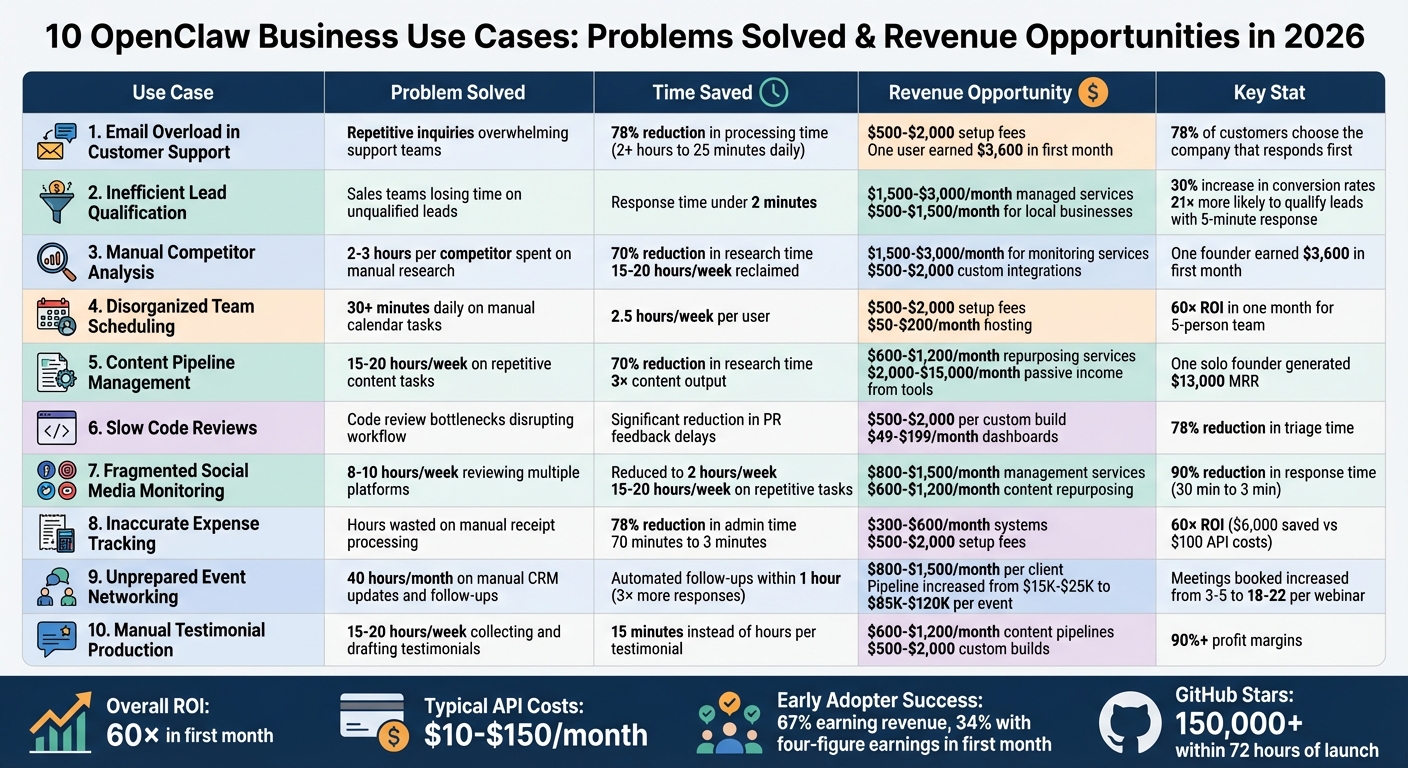
OpenClaw Business Use Cases: 10 Problems, ROI & Pricing Comparison 2026
1. Email Overload in Customer Support
Specific business problem solved
Support teams often struggle with an overwhelming number of repetitive inquiries, making it difficult to address urgent issues promptly. OpenClaw offers a solution by scanning Gmail or Outlook every 30 minutes, categorizing emails by urgency, and drafting responses using your knowledge base. Your team can then review and approve these drafts with a single click, cutting triage time from over 2 hours to just 25 minutes each day - a 78% reduction in processing time.
OpenClaw integrates seamlessly with support platforms like Zendesk, Freshdesk, and Intercom, while also pulling customer context from CRMs such as HubSpot and Salesforce. One user managed to clear 4,000+ unread emails in just two days using OpenClaw's automation capabilities. On top of that, the system sends prioritized alerts to communication tools like Slack or Telegram, ensuring critical issues are addressed immediately without the need to constantly monitor email inboxes.
Potential for monetization
The efficiency gains provided by OpenClaw not only streamline operations but also create new revenue opportunities. The demand for professional setup services for OpenClaw is growing rapidly. Technical consultants are charging between $500 and $2,000 for one-time deployments and security customizations for smaller businesses. One entrepreneur earned $3,600 in revenue during their first month by offering managed OpenClaw implementation services.
Additionally, businesses can develop industry-specific "skills" for OpenClaw, such as Shopify inventory management or real estate lead qualification, and sell them on platforms like ClawHub.
"I was losing at least 2–3 leads a month just because I couldn't respond fast enough. Now every inquiry gets a reply in under 5 minutes, 24/7. My close rate went up 30%." - Landscaping business owner
Speed is critical in customer support: 78% of customers choose the company that responds first. With OpenClaw, you can ensure instant, round-the-clock responses, turning missed opportunities into secured deals. And the cost? Monthly AI compute fees range from just $10 to $30, compared to hiring a virtual assistant, which can cost $1,500 to $3,000 per month.
Scalability of the solution
OpenClaw is built to grow with your business. You can add more agent instances as your support needs expand, all without increasing headcount. Each agent requires minimal resources - just 2 vCPUs, 2 GB of RAM, and 1 GB of storage. Unlike human assistants, OpenClaw operates 24/7 and delivers responses in seconds. Its persistent memory system stores ticket history and customer details, improving accuracy over time without the need for retraining.
Alignment with 2026 market trends
OpenClaw fits perfectly into the evolving business landscape of 2026. The trend is shifting from basic chatbots to autonomous "AI employees" capable of handling complex tasks. Its local-first architecture addresses rising concerns about data privacy and regulatory compliance by ensuring customer support data stays within your corporate network. This makes it suitable for industries governed by GDPR and HIPAA requirements.
The system's popularity reflects its potential: OpenClaw garnered 150,000+ GitHub stars within 72 hours of its early 2026 release. Businesses adopting these AI-driven workflows typically see returns on investment within 30 days. OpenClaw's ability to revolutionize email support is just one example of how it can transform business operations in the years ahead.
Explore AI Tools on Flaex.ai
Discover the best AI tools for your workflow, curated, reviewed, and ranked.
Browse Directory →2. Inefficient Lead Qualification in Sales
Specific Business Problem Solved
Sales teams often lose valuable time pursuing leads that don’t pan out, while genuinely promising prospects slip away unnoticed. OpenClaw tackles this issue by identifying businesses that align with your Ideal Customer Profile (ICP) across platforms like Google Maps, X (formerly Twitter), and Reddit. It analyzes prospect profiles and their post contexts for precise evaluations, then enriches the data with contact details, company size, and tech stack information. Leads are scored based on engagement signals such as email opens, link clicks, and sentiment analysis.
Quick response times are critical - engaging with a lead within 5 minutes makes a business 21 times more likely to qualify that lead compared to waiting 30 minutes. Yet, without automation, only 27% of leads are contacted, leaving the majority for competitors. OpenClaw addresses this "speed-to-lead" challenge by delivering responses in under 2 minutes and logging every interaction into CRMs like Salesforce or HubSpot. For example, a landscaping business owner reported a 30% increase in close rates after implementing OpenClaw's rapid response system.
These streamlined interactions not only save time but also create clear opportunities for revenue growth.
Potential for Monetization
The lead qualification market offers a range of revenue streams. Agencies can charge between $1,500 and $3,000 per month to B2B sales teams for managed services that monitor industry trends, identify prospects with specific needs, and enhance their profiles with contact details. Local service businesses - like plumbers or HVAC companies - can benefit from OpenClaw-powered phone agents that qualify leads 24/7, with fees ranging from $500 to $1,500 per month per business. This is especially valuable considering that 62% of calls to local service businesses go unanswered, potentially costing a $500,000-per-year business over $100,000 in lost revenue annually.
Developers, too, can profit by creating and selling custom automation tools on platforms like ClawHub. These integrations can fetch $500 to $2,000 per build. Additionally, the complexity of setting up OpenClaw opens doors to charge $500 to $2,000 for one-time deployments or $50 to $200 per month for managed hosting. Despite these earnings, API operating costs remain low, typically ranging from $10 to $150 per month.
Scalability of the Solution
OpenClaw is designed to scale effortlessly alongside growing workflow demands. Thanks to Docker containerization, businesses can run isolated instances for different teams or scale horizontally to handle larger volumes of leads. This ensures lead qualification happens within the critical 5-minute window, even during off-hours or sudden surges in activity.
Compared to virtual assistants, which cost $1,500 to $3,000 per month and work limited hours, OpenClaw provides round-the-clock service for just $10 to $40 per month, delivering responses in under 2 minutes. Automated follow-ups further improve lead-to-meeting conversion rates, boosting them from 5–15% to 20–35%, while prioritizing high-value leads for human follow-up. Early adopters have seen a 78% reduction in the time spent on email triage and processing.
Alignment with 2026 Market Trends
The sales landscape is evolving, with businesses increasingly adopting "agent swarms" that use multiple OpenClaw instances to manage different parts of the sales funnel. For example, one instance might monitor Reddit while another handles outreach and lead qualification. Multi-channel outreach is also becoming the norm, extending beyond email to platforms like WhatsApp, SMS, and Telegram, which can achieve response rates 3–5 times higher.
OpenClaw's local-first architecture is another key advantage, keeping lead data and personal information on the company’s network to address privacy concerns and comply with regulations like GDPR.
"78% of customers buy from the company that responds first. Not the best company. Not the cheapest. The first." - Espen, The CAIO
This market shift highlights the importance of scalable, continuous lead engagement. By integrating human-in-the-loop workflows, businesses can maintain brand integrity while allowing OpenClaw to handle up to 90% of the qualification process, escalating only the most promising leads to sales teams.
3. Manual Competitor Analysis in Marketing
Specific Business Problem Solved
In a world where AI is transforming workflows, staying ahead of competitors is more important than ever. Marketing teams often spend 2–3 hours per competitor manually checking pricing pages, blog updates, and social media activity. This slows down how quickly insights reach sales teams, creating a gap in response time. OpenClaw tackles this issue head-on by using browser automation to continuously monitor competitor websites, pricing changes, feature launches, and social media updates. The result? Real-time, actionable insights delivered directly to your team.
OpenClaw doesn't stop at just gathering data. It uses advanced AI to analyze changes - like a pricing update - and instantly sends alerts. Even better, it updates tools like Notion or Google Docs with the latest information, ensuring your battlecards are always current.
One example of this in action is Bhanu Teja P, the solo founder of SiteGPT, who earned $13,000 in monthly recurring revenue. In early 2026, he implemented a "Mission Control" system using multiple OpenClaw agents, including one dedicated solely to competitor analysis. This setup allowed him to manage comprehensive competitive intelligence on his own, proving that rapid responses are crucial in fast-paced industries.
Potential for Monetization
The competitive intelligence market offers plenty of ways to generate revenue. Agencies, for instance, can charge $1,500 to $3,000 per month for research and monitoring services. Meanwhile, operational costs remain low - around $25 to $65 per month for VPS hosting and AI API calls.
Take @elvissun on X as an example. They earned $3,600 in their first month by providing OpenClaw setup services and later secured a five-figure enterprise deal within days.
Developers can also profit by creating and selling specialized automation tools on the ClawHub marketplace. These tools, tailored for tasks like monitoring Shopify inventory or tracking real estate prices, sell for $10 to $200 each. For custom enterprise integrations, fees can range from $500 to $2,000 per project. Businesses are willing to invest $500 to $5,000 per month for automation that saves over 10 hours a week, while OpenClaw keeps costs at just $50 per month in API expenses.
Scalability of the Solution
OpenClaw's design allows marketing teams to expand their monitoring efforts without adding extra staff. Instead of hiring more researchers, companies can deploy "agent swarms" - specialized AI instances for tasks like SEO tracking, competitor analysis, and social media monitoring.
With cron jobs automating check frequencies, teams can:
- Run hourly scans for blog posts,
- Perform daily pricing updates,
- Conduct weekly job postings reviews to spot strategic shifts.
This efficiency translates into major time savings. Teams report reclaiming 15–20 hours per week previously spent on research and reporting. For example, a content audit of 50+ pages - once a full day's work - can now be completed in just 2 hours. This allows one person to handle tasks that used to require an entire team.
Alignment with 2026 Market Trends
By 2026, marketing has shifted from using AI for basic tasks to fully automating campaigns and research. Static quarterly reports are a thing of the past, replaced by instant alerts sent via Slack or Telegram the moment a competitor updates pricing or launches a new feature. In markets where timing is everything, this level of immediacy can make all the difference.
"In fast-moving markets, competitive intelligence isn't a quarterly report - it's a real-time feed." - MarketBetter
Another trend shaping the landscape is privacy-first automation. Companies are increasingly running agents locally or on private VPS setups to protect sensitive data. And while AI handles much of the heavy lifting - drafting updates and reports - a human touch is still essential. Teams rely on human reviewers to ensure that updates align with brand voice and strategic goals.
4. Disorganized Team Scheduling
Specific Business Problem Solved
Professionals often spend over 30 minutes each day juggling manual calendar tasks - checking availability, scheduling, and preparing for meetings. OpenClaw steps in as an AI-powered calendar assistant, seamlessly integrating with Google Calendar and Outlook. Users can set specific preferences using a "SOUL.md" file, such as ensuring a 15-minute break between meetings or keeping Fridays free of appointments. When a meeting request comes in, OpenClaw analyzes the request in natural language, checks the user's calendar, and suggests conflict-free time slots in a draft email - eliminating the tedious back-and-forth of scheduling. Additionally, it delivers "Meeting Prep" briefs 30–45 minutes before events, pulling relevant context from previous communications and CRM data.
Potential for Monetization
These scheduling efficiencies open up lucrative opportunities for both service providers and developers. Professional setup services start at $500, while hosting plans range from $50 to $200 per month. For solo professionals billing at $300 per hour, reclaiming even 3 hours of administrative time could translate to an additional $900 in daily earnings. Developers can also tap into this potential by creating specialized scheduling automations - like tools for real estate appointments or healthcare reminders - and selling them on the ClawHub marketplace for $10 to $200 each.
Scalability of the Solution
OpenClaw’s automated calendar management can save users roughly 2.5 hours per week. For a team of five, this efficiency could deliver a 60× return on investment in just one month. The platform uses multi-agent orchestration, where individual agents handle specific tasks while a lead agent manages coordination through a centralized "Mission Control" dashboard. Automated onboarding processes have been sped up significantly, shrinking what used to take 4 hours down to just 15 minutes - a 12× improvement. Additionally, the system runs automated scans every two hours to identify scheduling conflicts, notifying users only when necessary, which helps reduce notification fatigue. This level of optimization makes the solution applicable across a wide range of industries and teams.
Alignment with 2026 Market Trends
Gartner forecasts that by 2026, 40% of enterprise applications will include task-specific AI agents. As businesses move beyond basic chatbots to more advanced tools that handle multi-step workflows, OpenClaw sets itself apart with its deterministic, node-based workflows, ensuring precision rather than relying on conversational AI guesswork.
"OpenClaw replaces 'hope it's correct' with defined paths." - Samuel Su, Founder & CEO of Chat Data
With rising concerns about data privacy, many businesses are opting for local-first architectures, often running OpenClaw on self-hosted servers to protect sensitive calendar and client data. The system also supports integration with popular platforms like WhatsApp, Telegram, Slack, and Discord, allowing teams to manage schedules within their preferred apps. Its "Deep Work" feature further enhances productivity by automatically blocking meeting requests during focus periods. OpenClaw’s approach not only streamlines scheduling but also adapts to the evolving needs of modern business operations.
5. Time-Consuming Content Pipeline Management
Specific Business Problem Solved
Managing content workflows can be a massive time sink for marketing teams, with repetitive tasks like researching, drafting, and formatting eating up 15-20 hours every week. OpenClaw simplifies this process by automating the entire content pipeline. Instead of juggling multiple tools and manual steps, teams can rely on a single, streamlined system where data ingestion, cleaning, drafting, and delivery happen seamlessly.
The platform takes on the heavy lifting: it condenses keyword research that used to take hours into just 30 minutes, generates first drafts, and tweaks content for platforms like LinkedIn, X, and Instagram by adding tailored captions and UTM links. To maintain quality, a mandatory human review step ensures that while AI handles the groundwork, strategic decisions remain in human hands.
Potential for Monetization
Content repurposing services are in high demand, often priced between $600 and $1,200 per month, while the operational costs for OpenClaw are minimal, ranging from just $40 to $80 per month for LLM API fees. Beyond this, developers can create and sell specialized automation workflows - like podcast production or real estate follow-ups - on the ClawHub marketplace, earning anywhere from $2,000 to $15,000 per month in passive income.
A standout example comes from February 2026, when Bhanu Teja P, the solo founder of SiteGPT, used OpenClaw to implement a "Mission Control" dashboard. This setup allowed him to manage a swarm of agents for content research, SEO optimization, and social media posting, enabling his one-man operation to produce the equivalent output of an entire marketing team while generating $13,000 in monthly recurring revenue.
Scalability of the Solution
OpenClaw isn’t just about saving time - it’s about scaling up. It can triple content output without requiring additional staff. Research time is slashed by 70%, and KPI reporting, which used to take hours, now takes just 5 minutes. The system is designed to maintain quality through intermediate checks, offering samples of cleaned data or outlines during the process to catch errors early.
Alignment with 2026 Market Trends
The 2026 market is shifting toward AI that doesn’t just "chat" but actively "acts", executing complex workflows across multiple tools. Businesses are increasingly adopting "agent swarms" - specialized agents working in unison on different parts of the marketing funnel, such as SEO, social media, and competitor analysis. Additionally, rising privacy concerns are pushing companies toward self-hosted solutions like OpenClaw, which ensure sensitive data stays within their own networks. With over 50 messaging integrations, OpenClaw also allows teams to trigger and monitor their content pipelines directly from their phones.
"AI agents do not replace marketers - they amplify them. The teams getting the most value from OpenClaw are those that use it for research, data gathering, and first-draft generation while keeping human judgment firmly in charge." - Digital Applied
6. Slow Code Review in Development Teams
Specific Business Problem Solved
Code reviews often become a frustrating bottleneck for development teams.
"'Can you review this when you get a chance?' is the most dreaded Slack message. Code reviews were eating my evenings." - Ashish Maurya, Software Developer
The constant back-and-forth between GitHub, Slack, and CI/CD dashboards disrupts a developer's workflow. What should be a quick feedback loop turns into hours of delays. OpenClaw tackles this by continuously monitoring GitHub repositories, fetching pull request (PR) diffs, and delivering inline feedback directly through Telegram or Slack. Beyond just speeding up reviews, it identifies security vulnerabilities, flags problematic coding patterns, and even assigns labels or reviewers based on code changes. For teams with low test coverage, OpenClaw can autonomously generate unit test suites to meet specific coverage goals, like 90%.
A standout feature is the "Ralph Loop", which automates coding tasks. It writes code, runs tests, analyzes errors, and fixes issues until all tests pass. Once complete, it creates the final PR. This level of automation smooths out the development process, just as OpenClaw simplifies other business operations.
Potential for Monetization
Automating code reviews opens up strong revenue opportunities. Agencies can charge anywhere from $500 to $2,000 per build for custom OpenClaw skills tailored to meet enterprise coding standards. Security and compliance auditing is another profitable area, especially since researchers found that 7.1% of skills on the ClawHub marketplace were leaking API keys.
One indie developer earned $3,600 in their first month by offering managed OpenClaw services. There's also potential in offering "Mission Control" dashboards, priced between $49 and $199 per month, enabling businesses to manage multiple agents handling development, testing, and reviews simultaneously.
Scalability of the Solution
OpenClaw is designed to scale alongside growing codebases and increasing pull request volumes. Supervisor agents like "Patch" coordinate 5 to 20 parallel Claude Code instances across repositories, ensuring efficient handling of tasks. Each team operates within isolated Docker containers, ensuring secure and efficient resource management. Developers can even trigger fixes directly from their phones, making the process more flexible . Early enterprise users have reported significant time savings on manual triage for development-specific communications.
Alignment with 2026 Market Trends
By 2026, the focus is shifting from basic chatbots to advanced "super-agents" capable of executing shell commands, managing GitHub Actions, and handling multi-step autonomous fixes . Enterprises are leaning toward local-first architectures, with OpenClaw offering self-hosted solutions to keep proprietary code secure within internal networks.
In February 2026, Daniel Roedler, Co-founder and CPO at Octomind, introduced "OctoClaw" to automate repetitive workflows tied to both development and administrative tasks.
"By pointing the agent at Slack channels, his team transitioned from manual processing to a supervised 'show me what you'd do' model that validates data against approved lists before committing actions, allowing them to scale operations without increasing headcount."
This evolution reflects a broader trend of integrating smarter, autonomous tools into development workflows.
7. Fragmented Social Media Monitoring
Specific Business Problem Solved
OpenClaw transforms how businesses approach social media monitoring, saving time and effort for marketing teams. Instead of juggling multiple platforms like Twitter, LinkedIn, Reddit, Hacker News, Instagram, and WhatsApp, teams can centralize all monitoring into a single chat channel - be it Telegram, Slack, or WhatsApp. OpenClaw automates the process, scanning dashboards and delivering concise summaries directly to your team.
What sets OpenClaw apart is its focus on actionable insights. It filters out noise and sends alerts only when necessary - like when a post gains traction, a direct question is asked, or negative feedback arises. It even drafts responses tailored to your brand's SOUL.md guidelines and past interactions. For small teams, this means cutting weekly review time from 8–10 hours to just 2 hours.
Potential for Monetization
Agencies leveraging OpenClaw are charging clients between $800 and $1,500 per month for AI-driven social media management. With operational expenses around $50 per month for model API usage and hosting, the profit margins are impressive. Tech analyst Sonu Yadav highlights the value:
"Response time drops from 30 minutes to 3 minutes. That's a 90% reduction that clients immediately notice and value."
Businesses can also monetize through workshops and setup services. Live implementation workshops, priced at $100 for a 90-minute session, or professional setup services starting at $500 for configuration and 30-day support, offer additional revenue streams. Agencies are further capitalizing by repurposing content into platform-specific formats, charging between $600 and $1,200 per month. This combination of services and scalability makes OpenClaw a lucrative tool for businesses of all sizes.
Scalability of the Solution
OpenClaw is built to grow alongside your needs. It uses sub-agents to fetch data from multiple APIs simultaneously, avoiding delays even as monitoring demands increase. Marketing teams report saving 15–20 hours per week on repetitive tasks, and businesses see a 3× boost in content output without expanding their workforce. For a five-person team, the automation can deliver a 60× ROI in just one month by slashing manual labor costs.
Its self-hosted, local-first design ensures sensitive brand data stays secure within your network, addressing concerns about data privacy and GDPR compliance. However, a February 2026 audit revealed vulnerabilities in 42,000 OpenClaw installations due to default configuration settings. To secure your setup, update the default bind address from 0.0.0.0 to 127.0.0.1.
Alignment with 2026 Market Trends
As the market shifts toward autonomous "AI team members", OpenClaw stands out by going beyond basic scheduling tools. It not only schedules and publishes but also researches trends and drafts tailored responses across platforms. By early 2026, OpenClaw had amassed over 180,000 GitHub stars, reflecting its rapid adoption.
With the EU AI Act taking effect on March 1, 2026, tools that help navigate regulatory changes are in high demand. OpenClaw is already being used to monitor these shifts in real-time. Additionally, the rise of "vibe coding", where AI generates content based on broad intent, aligns perfectly with OpenClaw’s natural language configuration approach. This makes it a forward-thinking solution in a rapidly evolving digital landscape.
8. Inaccurate Expense Tracking for Finance
Specific Business Problem Solved
Finance teams often waste hours hunting down receipts, manually inputting data, and fixing errors. OpenClaw eliminates these inefficiencies by automating the entire expense tracking process. For example, an employee can simply text, "Spent $45 on lunch with a client", through platforms like WhatsApp, Telegram, or Slack. OpenClaw instantly extracts the details. For paper receipts, it uses OCR and language models to pull vendor names, amounts, and dates directly from the document. This is part of OpenClaw's broader mission to replace tedious manual tasks with efficient AI-powered workflows.
The platform’s data-validator skill further enhances accuracy by flagging issues like missing values, duplicate entries, or expenses that exceed company policy limits before they make it into final reports. OpenClaw also integrates with accounting APIs to perform variance analysis and delivers fully formatted PDFs directly to leadership - reducing manual work from 70 minutes to just 3 minutes. This time-saving process not only boosts productivity but also creates opportunities for businesses to monetize these services.
Potential for Monetization
Smart expense tracking setups powered by OpenClaw can generate significant revenue. Developers typically charge between $300 and $600 per month for these systems, with additional one-time fees ranging from $500 to $2,000 for setup and security enhancements. Meanwhile, operational costs for API usage and hosting remain low, around $20–$40 per month, ensuring healthy profit margins.
A great example of this potential is indie hacker @elvissun, who launched an OpenClaw setup-as-a-service business in January 2026. Within the first month, they secured a $3,600 Stripe payment and even closed a five-figure enterprise deal within just five days. For a small five-person team, automating expense reporting can deliver a massive return on investment - saving around $6,000 in the first month while spending only $100 on API costs, a 60× ROI.
Scalability of the Solution
OpenClaw's design makes it easy to scale as teams grow. Instead of training employees on complicated accounting tools, they can simply text their expenses in plain English. The system takes care of data entry, categorization, and report generation, working seamlessly with tools like Google Sheets, Excel, and various accounting APIs. Early adopters in enterprise settings have reported a 78% decrease in time spent on administrative tasks.
However, managing costs becomes essential as usage scales. For instance, Federico Viticci, a technology writer, spent $3,600 in one month on API costs while using OpenClaw for advanced automation. To avoid such expenses spiraling out of control, users can set daily cost limits (max_cost_per_day) and create approval steps for high-value transactions. Additionally, security remains a concern - researchers found that 7.1% of skills on the ClawHub marketplace were leaking API keys and credentials in early 2026.
Alignment with 2026 Market Trends
OpenClaw’s local-first architecture ensures financial data stays within the corporate network, a critical feature for industries with strict regulations. This approach addresses growing concerns about data sovereignty and compliance with GDPR, aligning with the 2026 trend toward self-hosted AI agents that prevent sensitive data from being used in third-party model training.
The platform also embraces the evolution of AI from simple chatbots to advanced AI agents capable of handling complex, multi-step workflows. Its "Heartbeat" monitoring system checks for budget overruns or suspicious transactions every 30 minutes without requiring user input. As one industry expert from SuperFrameworks observed:
"The biggest opportunities are in the gaps OpenClaw leaves open: setup complexity, security, cost management, monitoring, and vertical skills." – SuperFrameworks
With its focus on automation, secure data handling, and proactive monitoring, OpenClaw is perfectly positioned to meet the needs of finance teams in 2026.
9. Unprepared Event Networking
Specific Business Problem Solved
Attending a conference or business event without preparation can mean missed opportunities for professionals. On top of that, manual tasks like updating CRMs or drafting follow-up emails can take up around 40 hours each month for sales reps. Timing is critical - lead interest drops sharply, by 50% within 24 hours and 80% within 48 hours after an event. OpenClaw tackles this issue by automating the entire networking process.
The platform gathers context from CRM data, email exchanges, and social media profiles to create detailed pre-meeting briefs on attendees. After conversations, it processes transcripts and notes to draft personalized follow-up emails or LinkedIn messages, addressing specific pain points discussed. OpenClaw also evaluates engagement signals - like questions asked during sessions or time spent at booths - to categorize leads as Hot, Warm, or Cool. This structured data, along with next steps, is then synced to CRMs like HubSpot, Salesforce, or Pipedrive. Research shows that prospects who receive personalized follow-ups within an hour are three times more likely to respond compared to those contacted a day later. By streamlining follow-ups, OpenClaw helps businesses capture more opportunities and drive revenue growth.
Potential for Monetization
Automating networking workflows with OpenClaw opens up lucrative revenue streams. For example, businesses have seen a jump in meetings booked - from 3–5 per webinar to 18–22 per webinar. Additionally, automation can increase pipeline generation from $15K–$25K to $85K–$120K per event, leveraging lead interest more effectively. Developers and consultants managing these automated workflows typically charge $800–$1,500 per month per client, while operational costs remain low - around $30–$60 per month for API fees and $10–$20 for hosting. This cost-efficiency translates into profit margins exceeding 90%. Among early adopters using OpenClaw agents in 2026, 67% are already earning revenue, with 34% reporting four-figure earnings within their first month. The secret lies in deploying agents to engage leads at their peak interest, automating tasks that would otherwise consume valuable time for sales teams.
Scalability of the Solution
OpenClaw's design allows it to scale effortlessly, whether for a single event or a full conference series. Businesses can host the platform on a Virtual Private Server (VPS) to ensure continuous operation, rather than relying on a personal device. Its persistent memory retains context over months, even recognizing repeat attendees across multiple events. This enables the system to adjust engagement strategies, escalating interactions with warmer leads. Leads are scored into three categories - Hot (80+ points), Warm (50–79), and Cool (20–49) - and real-time alerts are sent through Telegram or WhatsApp when a Hot lead is identified or a meeting is requested. For businesses new to the platform, granting agents "read-only" access and requiring human review for outgoing messages is a smart way to ensure quality until confidence in the system grows.
Alignment with 2026 Market Trends
OpenClaw's automated networking capabilities align perfectly with the evolving demands of 2026. As with its success in support and lead qualification, the platform transforms event networking by ensuring timely, personalized engagement. It taps into the growing preference for local-first, chat-native automation, where agents operate on private hardware or VPS setups to address data privacy concerns. This approach is particularly relevant for managing sensitive CRM and networking data.
Unlike basic chatbots, OpenClaw functions as an autonomous agent capable of completing complex workflows - researching attendees, booking meetings, and updating databases. By supporting specialized sub-agents for tasks like research and outreach, it fits seamlessly into the emerging trend of multi-agent systems. With professionals increasingly managing their networking through messaging apps, OpenClaw's chat-native design simplifies the process while excelling in areas like setup, security, cost efficiency, and monitoring.
10. Manual Testimonial Production
Specific Business Problem Solved
Collecting testimonials manually can eat up 15–20 hours every week. Marketing teams often spend 3–4 hours digging through emails, Slack messages, and support tickets just to find usable customer feedback. Then, another 2–3 hours go into crafting a single piece of social proof content.
OpenClaw simplifies this process by monitoring platforms like Slack, email, and WhatsApp to automatically capture positive customer feedback in real time. Its persistent memory stores praise and project details from past interactions. When it’s time to create a testimonial, OpenClaw pulls relevant customer success data, drafts the content, and queues it for review - all within 15 minutes instead of hours. Using Retrieval-Augmented Generation (RAG) tools, it builds a searchable database of customer feedback, making it easy to find specific quotes for tailored marketing campaigns. The result? Testimonials that feel personal and authentic, ready to fuel scalable revenue strategies.
Potential for Monetization
This testimonial tool fits neatly into OpenClaw’s broader mission of automating repetitive tasks. Developers and agencies typically charge $600–$1,200 per month to manage automated content pipelines for clients, while operational costs hover around $50 per month in API fees. That’s a profit margin of over 90%. Businesses are willing to pay $500–$5,000 monthly for automations that save them at least 10 hours of manual work every week.
"The opportunity: Businesses pay $500–$5,000/month for automation that saves 10+ hours weekly. OpenClaw can deliver this at $50/month in API costs." - Markaicode
Developers can also create and sell specialized testimonial collection tools on the ClawHub marketplace, targeting industries like real estate or e-commerce. These skills can generate $100–$1,000 per month in passive income, while custom builds can command one-time fees of $500–$2,000. Among early adopters, 67% are already earning revenue, with 34% reporting four-figure earnings in their first month.
Scalability of the Solution
OpenClaw’s multi-agent setup allows businesses to scale testimonial production across multiple client accounts with ease. Teams can deploy agent "swarms" to handle large volumes while maintaining consistency through persistent memory. With over 50 integrations, the platform supports automatic cross-posting of testimonials to Slack, WhatsApp, Telegram, Discord, and various social channels.
To ensure quality, businesses can start with human approval (require_approval: true) before gradually increasing automation as confidence builds. For early testing, users can run local models like Llama 3.2 via Ollama at zero API cost, then transition to cloud-based processing for larger-scale operations. Approval gates and multi-channel monitoring ensure testimonials remain authentic and aligned with active customer feedback.
Alignment with 2026 Market Trends
OpenClaw’s testimonial automation aligns perfectly with the evolving AI landscape of 2026. AI is shifting from simple chatbots to autonomous agents capable of managing complex workflows. With 73% of marketers planning to adopt AI agents this year, tools that streamline execution-heavy tasks are in high demand. OpenClaw’s viral launch in early 2026, which earned over 150,000 GitHub stars within 72 hours, highlights its massive appeal.
The platform’s local-first design addresses growing concerns about data privacy and GDPR compliance by allowing businesses to run agents on private hardware or VPS instances. Early enterprise users have reported a 78% reduction in time spent managing communication triage. As one industry expert puts it:
"AI agents do not replace marketers - they amplify them. Strategy stays human. Execution gets faster." - Digital Applied
This approach fits seamlessly with 2026’s emphasis on scalable, personalized marketing, delivering tailored and credible content backed by real data.
Making $$ with OpenClaw
Conclusion
OpenClaw takes the hassle out of repetitive tasks across key areas like customer support, sales, marketing, development, and finance. The examples above highlight how these efficiencies directly boost revenue and drive growth. Early adopters have reported impressive results: a 78% cut in email processing time, onboarding clients 12 times faster, and achieving a staggering 60× ROI within just one month. These gains translate to saving around $6,000 in labor costs for only $100 in API fees.
This isn't just hype - autonomous agents are already transforming workflows. From automating email triage to managing testimonials and tracking expenses, OpenClaw's local-first architecture ensures your data stays secure, while its natural language interface eliminates the need for complicated setups.
"The mundane use cases are the valuable ones. Clearing email beats building sentient AI. Focus on boring tasks that actually eat your time." - KD Deshpande, CEO of Simplified
Every example underscores how OpenClaw helps reclaim time, boost productivity, and unlock new revenue opportunities. Whether you're looking to streamline support, speed up lead qualification, or automate content creation, the platform delivers measurable results.
To get started, identify the task that drains the most time in your workflow. Enable approval gates, deploy OpenClaw on a secured VPS, and set a daily API budget of $5–$10. Keep track of the hours saved and calculate your ROI using this formula: (Monthly Time Saved × Hourly Rate) - (API Costs + Maintenance). If the results are promising, expand to other departments.
The real value lies in reclaiming time and turning those saved hours into revenue. OpenClaw is free to deploy and ready to use. The question isn't whether AI agents will transform your business by 2026 - it’s whether you’ll be ahead of the curve or playing catch-up.
Featured on Flaex