
Replit Agent 4 review: the creative AI coding studio that changes the market in 2026
Flaex Team
Replit Agent 4 is not being launched as just another AI coding assistant. Replit is positioning it as its fastest, most versatile agent yet, built to help users plan, design, and build all at once while staying in creative flow. The big shift is not simply that it writes code. It is that Replit is trying to turn software creation into a collaborative, multi-agent, multi-output studio rather than a linear prompt-to-code workflow.
That matters because the AI coding market in 2026 is already crowded.
Cursor has gone deep on agentic development and automations.
v0 has evolved into a serious full-stack web app builder with Git integration and a real editor.
Windsurf continues to push the agentic IDE narrative.
GitHub Copilot now spans editor, terminal, issues, PRs, and even parallelized subagents in CLI.
Replit’s answer is to compete on a different layer: creative collaboration, parallel execution, built-in infra, and one project producing many artifacts.
What is Replit Agent 4?
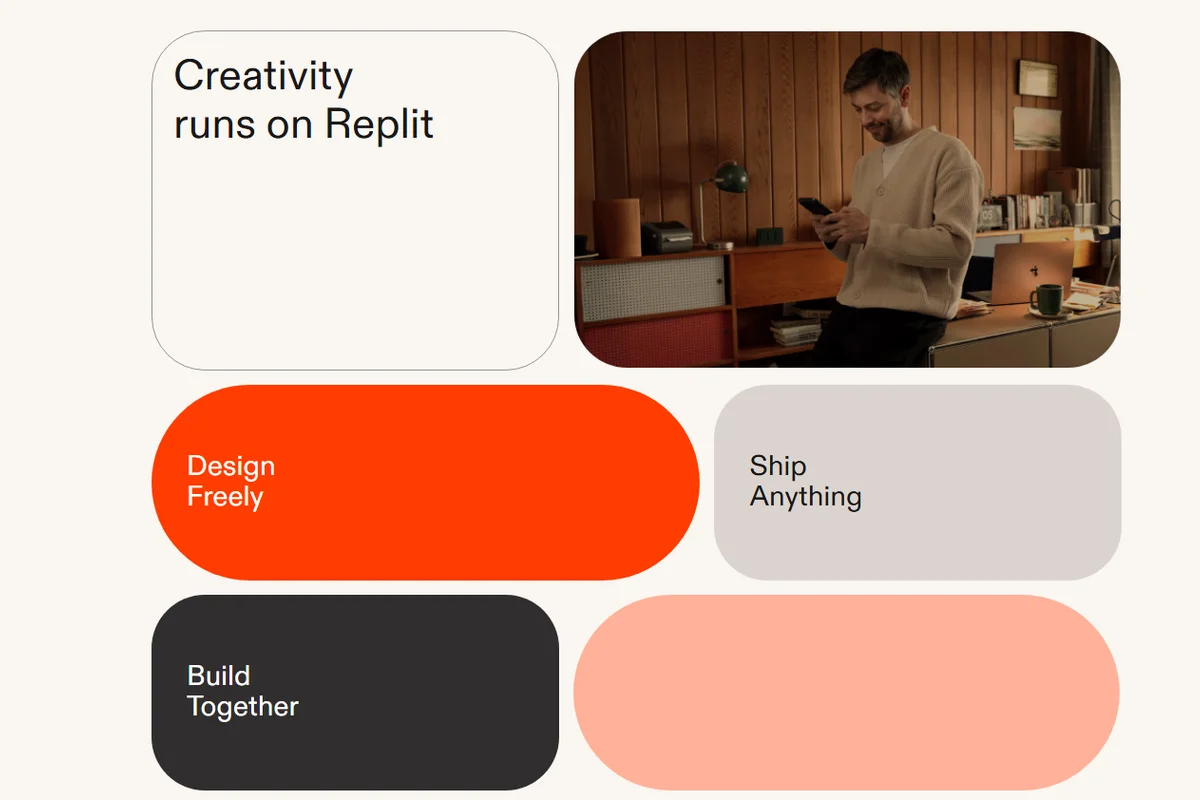
According to Replit’s docs, Replit Agent turns plain-language ideas into apps, designs, slides, and more, handling setup, building, testing, fixing, and deployment. Agent 4 builds on that base with a launch centered around four pillars: design freely, move faster, ship anything, and build together.
Replit’s official launch post describes Agent 4 as built around a simple idea: users should spend more time creating and less time coordinating. The company says Agent 4 is designed to keep people in creative flow and help them ship production-ready software faster inside the same environment where software is built, run, and shipped.
The real innovation: Replit is merging design, coding, coordination, and shipping
The strongest part of the launch is not a single feature. It is the product philosophy. Most AI coding tools still feel like one of these:
an AI inside your IDE
a prompt-based builder that generates a web app
a copilot for PRs, code edits, and terminal work
Replit Agent 4 tries to be broader than that. It combines visual design exploration, task orchestration, cloud execution, team collaboration, and built-in infrastructure in one place. Replit’s own site says projects can create mobile and web apps, landing pages, and videos in one project with shared design, while parallel agents handle tasks like auth, database work, and design at the same time.
That is the key market angle: Replit Agent 4 is less “copilot” and more “creative project operating system.” This is also consistent with Amjad Masad’s launch framing around creative collaboration between humans and agents.
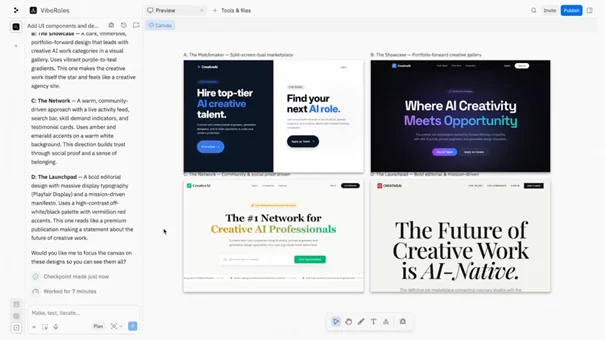
Impressive to see the new UI, UX and how easy it was to generate 4 landing pages variations :
1. Infinite canvas makes Replit Agent 4 feel different from most coding agents
One of the most differentiated features is the new infinite canvas. Replit says Agent 4 lets users generate design variants on a canvas, tweak them visually, and then apply the chosen version directly into the app. The launch post also mentions more precise controls like multi-select, hover and active-state editing, responsive overrides, preview interactions, and undo, with changes applied straight to production code.
This matters strategically because it attacks a common weakness in AI coding tools: design iteration often lives outside the main build loop. In many teams, the workflow still fragments across design tools, chat threads, code editors, and deployment platforms. Replit’s bet is that if design and build happen in the same live environment, iteration speeds up and coordination overhead drops.
Compared with the market, Cursor has added a visual editor in the browser and talks about raising the abstraction level, and v0 has strong design and full-stack web generation workflows. But Replit’s launch pushes harder on the idea that visual exploration, active app building, and agent execution should happen in the same project context at the same time.
2. Parallel agents are one of the biggest reasons Agent 4 matters
Replit says Agent 4 can work on multiple tasks in parallel, show progress across them, and merge the completed work back into the main project. It can also break larger tasks into smaller pieces, run them simultaneously with sub-agents, and recombine the results. Replit further says that when changes conflict, specialized sub-agents can help resolve them.
This is not just a speed feature. It changes the user experience. Instead of a single-thread chat where you wait for one action at a time, Replit is pushing a task-based workflow that behaves more like managing a team. The launch material explicitly frames the product around visible progress, sequencing, clean handoffs, and less overhead.
This is where Agent 4 looks strongest against more linear tools. Cursor does support agentic development and now has automations that run on triggers from Slack, Linear, GitHub, PagerDuty, and webhooks, which is powerful for ongoing workflows. GitHub Copilot CLI also advertises /fleet-style parallelized subagents. But Replit’s positioning is more visible and collaborative at the project layer, not just powerful at the coding-agent layer.
3. Replit is expanding from "build an app" to "ship the whole project"
Replit’s launch post says Agent 4 can build not just web and mobile apps, but also slide decks, data apps, and animations in the same project with shared context and design. The product page similarly highlights mobile and web apps, landing pages, and videos from one project. The docs also describe Replit Agent as turning ideas into apps, designs, slides, and more.
That is a meaningful market distinction. Most AI coding tools still optimize around code output, or at most web-app output. Replit is trying to turn the project itself into the unit of creation, so the app, deck, launch assets, and related outputs all share the same context. If Replit executes this well, it could become attractive not just to engineers, but to founders, product managers, agencies, and small teams that need one workspace for building and shipping.
Against the market:
v0 is strong for full-stack web apps and production-ready previews, but it stays closer to the Vercel/web app universe.
Cursor is strong for developer productivity and agentic coding, but not positioned as a multi-artifact shipping environment.
GitHub Copilot remains repo and coding workflow centric.
Windsurf remains IDE-first.
4. Team collaboration is where Replit may be underrated
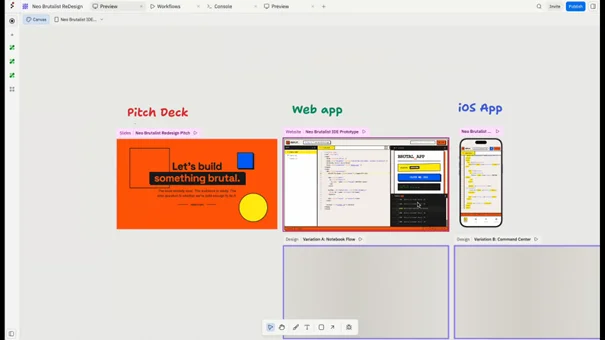
Replit’s new story is not only about solo vibe coding. The product site and launch post both emphasize support for teams, shared work, and a task-based collaborative flow. Replit says team members can send multiple design or build requests at the same time, track each task, review the results, and approve them before merge. The site also highlights team support and shared progress visibility.
That gives Replit a differentiated path in a market where many AI coding products still feel optimized for a single developer sitting in a local environment. Cursor and Windsurf have strong team stories, and v0 has team plans and shared projects, but Replit’s approach feels more like multi-user vibe coding with agent orchestration rather than “everyone has an AI in their own editor.”
Replit Agent 4 vs the current market
Replit Agent 4 vs Cursor
Cursor is one of the strongest products in the market for developers who want AI directly inside the coding loop. Cursor’s site says agents turn ideas into code and let developers hand off tasks while focusing on decisions. Cursor also has plan mode and, more recently, automations that create always-on agents triggered by external events and powered by MCPs and memory.
Replit Agent 4 is broader. It is less about “best AI editor” and more about “best collaborative creative build environment.” Cursor is probably still the cleaner pick for developers who live inside the IDE and want maximum code-first leverage. Replit looks stronger for teams that want visual iteration, cloud-native collaboration, built-in hosting, and a project that can output more than just code.
Replit Agent 4 vs v0
v0 is a serious competitor now. Its February 2026 update added Git integration, projects/folders, a full VS Code-style editor, and previews that run code as it would in production. The docs describe it as a platform that turns ideas into production-ready, full-stack web apps, with deep Vercel integration, design mode, code editing, and shared workspaces.
Where v0 wins is focused web product generation and Vercel-native shipping. Where Replit Agent 4 stands apart is scope: parallel agents, multi-artifact outputs, stronger “creative studio” branding, and a more explicit human-plus-agent task orchestration story. If your world is mostly Next.js web products, v0 is extremely compelling. If you want a broader cloud workspace for collaborative creation and shipping, Replit has a different and potentially bigger ambition.
Replit Agent 4 vs Windsurf
Windsurf’s homepage describes it as the most intuitive AI coding experience and the best AI for coding, built to keep developers and teams in flow. That is a strong coding-IDE proposition.
Replit Agent 4 overlaps on the flow narrative, but it expresses it differently. Windsurf is still clearly an AI coding environment for developers. Replit is trying to define a broader space where agents, humans, design, build, deployment, and other artifacts all coexist in the same creative workflow. So the real choice is not only about coding quality. It is also about whether you want an IDE-centered flow or a project-centered flow.
Replit Agent 4 vs GitHub Copilot
GitHub Copilot is now much more than autocomplete. GitHub says Copilot in the editor can propose edits and validate files with agent mode, and Copilot CLI can build, debug, and deploy from the terminal, with GitHub context and MCP support. Copilot CLI also promotes a /fleet of parallelized subagents.
Still, GitHub Copilot remains centered on the GitHub ecosystem, the editor, the terminal, issues, and PRs. Replit Agent 4 is aiming at something more experiential: a unified environment where the user can ideate visually, delegate tasks, collaborate with a team, and ship multiple outputs without leaving the project. That makes Replit feel less like a GitHub-native coding layer and more like a creative build platform.
Pricing and who Replit Agent 4 is really for
Replit currently offers Starter, Core, Pro, and Enterprise plans.
Core is listed at $20/month, while Pro is listed at $95/month billed annually, with more credits, up to 15 collaborators, access to the most powerful models, and private deployments.
Enterprise adds custom seats, SSO/SAML, and enterprise controls.
Replit’s deployment docs also note that Starter includes one free published app.
The launch post adds an important restriction: parallel task execution is intended for Pro and Enterprise, though Replit says it is making it temporarily available to Core users for a limited time after launch.
That suggests the strongest fit right now is:
agencies
startup teams
product managers working closely with builders
founders who want one cloud-native build-and-ship workspace
teams that care about speed, collaboration, and reduced context switching
For a solo developer who already lives happily in a local IDE, Cursor or Windsurf may still feel more natural. For a GitHub-heavy engineering org, Copilot may remain the easiest extension of existing workflows. For a Vercel-native web team, v0 may still be the cleanest focused choice. But for teams that want a more creative, shared, all-in-one project environment, Agent 4 is one of the most interesting launches in the market right now.
Final verdict: Agent 4 is one of the clearest signs that AI coding is moving beyond the IDE
The most important thing about Replit Agent 4 is not that it has infinite canvas, or parallel agents, or multi-artifact outputs individually. It is that Replit is combining them into a coherent claim: software creation is becoming creative, collaborative, and multi-agent by default.
In other words, the market is splitting into clearer categories:
AI coding IDEs like Cursor and Windsurf
GitHub-native agent ecosystems like Copilot
web-product builders like v0
creative project studios like Replit Agent 4
That is why this launch matters. Replit is not merely chasing the coding assistant race. It is trying to define a new category at the intersection of design, execution, collaboration, and shipping. Whether it fully delivers on that promise will depend on reliability, quality under real workloads, and how well teams adopt the new workflow. But as a product introduction, Agent 4 is one of the most strategically distinct AI development launches of 2026 so far outside of openclaw.
Featured on Flaex